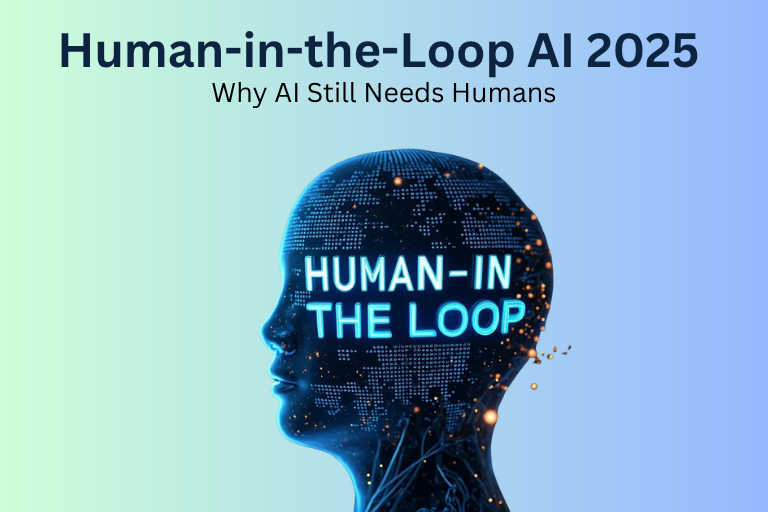
Can AI truly operate without human oversight? No & the answer is changing how we see automation.
In a factory where AI checks products and spots defects with 99% accuracy. But before it makes a big decision, it stumbles. Human intervention becomes crucial.
The term is called Human-in-the-Loop AI. It’s smart tech with human backup. Together, they make better, safer choices.
This teamwork model blends AI’s speed and accuracy with human insight. Humans add creativity, common sense, and ethical thinking.
Recent reports show the results: Companies using this approach saw 35% fewer errors. And a 28% boost in overall efficiency.
This guide explores the concept of Hybrid Intelligence, where AI and humans collaborate.

What Makes Human-in-the-Loop RPA Different from Traditional Automation?
Human in the loop RPA (Robotic Process Automation) is a game-changer. It moves away from the old “set it and forget it” style of automation.
Traditional RPA follows fixed rules, no questions asked. It runs tasks like a robot, start to finish.
But HITL RPA adds smart checkpoints. Humans can step in, check the work, or make changes.
It’s automation with a safety net. Fast, but flexible. Smart, but still human-aware.
Key Differentiators:
- Adaptive Decision-Making: Human-in-the-Loop RPA can deal with tricky or unusual situations that basic automation might miss.
- Continuous Learning: Human feedback provides continuous improvement of the system’s performance over the course of time.
- Risk Mitigation: Critical decisions undergo human review before execution, dramatically reducing the cost of errors
- Contextual Understanding: Humans provide a nuanced interpretation of complex scenarios that pure algorithms might mishandle
Imagine a customer asking for a refund. An RPA system handles the request automatically. Old-school automation checks a few rules and takes the final decision.
But Human-in-the-Loop RPA does more. It spots unusual cases, like loyal customers with special issues. Then it sends those to a human for review.
This teamwork creates something powerful: augmented intelligence. That means tech helps humans, not replaces them.
It boosts what people can do. Makes decisions faster, wiser, and more accurately.
In fact, some studies show that combining human judgment with AI can lead to much better results than either working alone.
According to Forbes, AI agents can now replicate 85% of a person’s personality after just a two-hour interview. That’s how far human-AI collaboration has come.
How Does HITL Transform Decision-Making Processes?
Human-in-the-Loop (HITL) changes how companies make big decisions. It adds smart checkpoints inside automated systems.
AI is great at handling loads of data, fast and accurately. But humans bring something AI can’t: Emotional intelligence, ethics, and creativity.
Together, they make smarter, safer choices. It’s not just automation; in fact, it’s thoughtful automation.
The HITL Decision Framework:
AI Processing
AI systems handle routine data analysis, pattern recognition, and preliminary assessments at machine speed, processing thousands of inputs per minute.
Exception Identification
Advanced algorithms flag anomalies, edge cases, or situations requiring human judgment based on predefined confidence thresholds.
Human Review
Qualified personnel evaluate flagged cases, bringing contextual knowledge, industry expertise, and ethical considerations to complex decisions.
Feedback Integration
Human choices contribute to enable teaching the AI, the smartest it gets with time. This is particularly good for healthcare professionals.
AI rapidly reads medical images, but doctors validate the diagnosis. Human-in-the-Loop technology enables radiologists to get fast results while being less prone to error with its combination of AI speed and human accuracy.

Banks and financial companies are also using Human-in-the-Loop (HITL) systems. AI can quickly spot suspicious transactions. But it doesn’t always understand the whole story.
That’s where humans step in. Analysts look at customer history and behavior. They decide whether to block the account or let it go.
It’s smart tech with human judgment: fast alerts, thoughtful decisions.
Why Is Human in the Loop Automation Essential for High-Stakes Industries?
Human-in-the-Loop automation is now a must in high-stakes industries like healthcare, finance, aviation, and legal services.
In these fields, mistakes can be severe. That’s why speed alone isn’t enough.
They need both efficiency and trust. AI brings speed. Humans bring judgment.
Together, they create more intelligent, efficient systems.
Critical Applications:
Healthcare Diagnostics
AI systems can analyze thousands of medical images per hour, but final diagnostic decisions require physician expertise. A report shows that the AI radiology system has improved diagnostic speed by 48-54%.
Financial Risk Management
Banks use human-in-the-loop automation to process loan applications, where AI handles initial creditworthiness assessment, but human underwriters evaluate complex financial situations and make final approval decisions. Lead list building tools complement this by ensuring decision-makers have the most complete, accurate business data at hand.
Legal Document Review
Law firms employ HITL systems for contract analysis, where AI identifies relevant clauses and potential issues, but attorneys provide legal interpretation and strategic advice.
Autonomous Vehicle Development
The most capable self-driving car would still need human control over edge cases and ethical decisions, especially in emergency situations in which the real-time human judgement is paramount.
The successful implementation of HITL is reflected in the presence of modern autopilot systems in the aviation industry. Though the aircraft can fly for a few hours with a self-pilot system, the pilots are available whenever there is a critical moment, especially during takeoff, landing, or emergency cases.
Aviation has become safer than ever. 2023 was the safest year on record. Thanks to more innovative tech, better training, and human-AI teamwork.
While HITL plays a role, the drop in accidents comes from many improvements working together. It’s a full-system upgrade, not just one feature.
What Are the Key Benefits of Implementing Human-in-the-Loop Systems?
Companies using Human-in-the-Loop AI are seeing big wins. They’re improving performance across the board.
Why? Because AI is fast and smart. Humans add judgment, creativity, and experience.
Together, they create results that neither could achieve alone. It’s a potent mix and a real edge in today’s market.
Quantifiable Benefits:
Enhanced Accuracy
Companies report accuracy improvements of 25-40% when combining AI capabilities with human oversight compared to fully automated systems.
Reduced Operational Costs
While requiring human involvement might seem expensive, HITL systems reduce costs by preventing costly errors. Insurance companies using HITL for claims processing report 30% fewer disputed decisions.
Improved Compliance
Regulated industries benefit from human validation of AI decisions, ensuring adherence to complex regulatory requirements that pure algorithms might misinterpret. Emerging frameworks like Gemini AI security further support this process by adding advanced safeguards that help organizations maintain compliance and protect sensitive data within AI-driven workflows.
Scalable Quality Control
HITL systems can handle increased workloads without proportional increases in quality control staff, as AI pre-filters routine cases for human experts to focus on exceptions.
Human-in-the-Loop systems build trust and improve over time with human feedback. They also help catch errors that automation might miss, making decisions safer and more reliable.

How Can Organizations Successfully Implement Human-in-the-Loop Solutions?
To effectively employ Human-in-the-Loop, it is essential to conduct good planning, have adequate technological infrastructure, and a well-thought design of human-AI interaction. The upgraded technological approach of automation in an organization requires balancing the use of human expertise and automation efficiency, as well as an effortless integration of workflows.
Implementation Framework:
Process Assessment
Identify tasks where human judgment is essential. Set clear rules for when AI should pass decisions to a human.
Human Resource Planning
Train staff to know when to trust AI and when to step in. Help them understand AI outputs and give helpful feedback.
Continuous Optimization
Measure how well the system performs over time. Adjust rules, confidence levels, and training based on real-world results.
Best Practices:
- Begin with low-risk processes to gain trust and experience in getting things done.
- Define uncomplicated escalation requirements and decision-making plans
- Go with simple user interfaces that support seamless human-AI interaction
- Create a feedback loop machine through which AI can be taught with the pattern of human decision-making.
- Keep track of and adjust the trade-off that exists between automation and human interaction
Amazon combines AI and human touches into its recommendation systems. Although AI proposes the products, they are refined by the human curators who add selection to special events or campaigns.
This mix helps improve relevance and customer experience, often leading to better conversions than AI alone.
Wrapping Up
The companies that are adopting Human-in-the-loop-AI type of teamwork are gaining tremendous advantages, such as improved accuracy, increased levels of customer trust, and ease of following the regulations.
The future isn’t about replacing people with AI. It’s about using AI to boost human skills and make smarter decisions. By adding key human checkpoints into automated systems, businesses get the speed of machines plus the wisdom of people.
Want to adopt Human-in-the-Loop AI in your organisation? Contact automation experts today and learn how it can help in streamlining your workflows without forgetting the human touch that your customers appreciate.
FAQs About Human-in-the-Loop AI
What is the difference between human-in-the-loop and AI in the loop?
Human-in-the-loop AI refers to decisions made by the system, with humans being introduced to review and rectify decisions as necessary. On the contrary, AI-in-the-Loop introduces people in the control, and AI is a beneficial add-on, which indicates patterns, makes recommendations, and simplifies work. It is the issue of the leader and the follower.
What is Human in the Loop AI, and how does it work?
Human in the Loop AI is the critical collaborative approach to artificial intelligence that implements automation through artificial intelligence, along with strategic points of human intervention where actions and decisions can be called into question by humans on a case-by-case basis.
Which industries benefit most from HITL implementation?
The HITL system is of great value in healthcare, finance management, legal services, and manufacturing environments because it involves a high-stakes decision-making process and regulatory compliance.
What’s the difference between HITL and fully automated systems?
HITL systems are characterized by the presence of human intervention points and validation points, as well as guidance, whereas fully automated systems do not require operator intervention at all.