Google has rolled out three new members of the Gemini AI family: the Gemini 3.6 Flash, Gemini 3.5 Flash-Lite, and the Gemini 3.5 Flash Cyber. Rather than coming out with just one model that does all tasks, Google is expanding Gemini’s family of models with their specific capabilities geared towards programming, automation, and cybersecurity.
This step reflects Google’s commitment to more practical AI development that delivers more efficient results while incurring lower operating costs.
What Google Announced
Recently, Google released the Gemini update that contains three types of models. Gemini 3.6 Flash is the new and fast Flash model that provides improved logic, programming skills, and technology for multitasking. In contrast to Gemini 3.6, Gemini 3.5 Flash-Lite is developed to ensure a fast and cheap process of service for organizations taking thousands of inquiries. Finally, there is also Gemini 3.5 Flash Cyber model created for detection of internet crimes, allowing security workers to identify threats and design a plan of action.
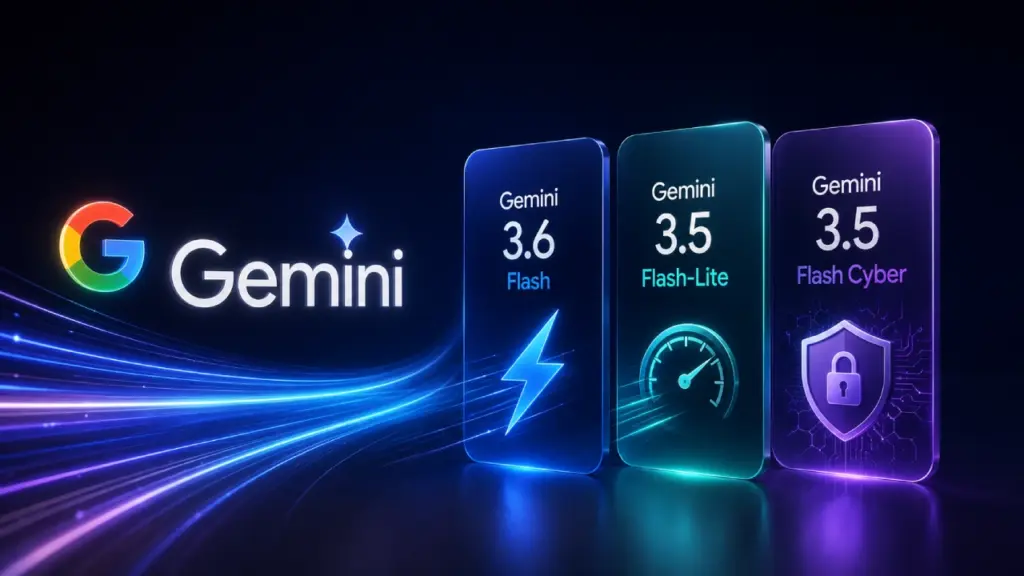
All the above-mentioned three models give developers a better opportunity for selecting an optimal combination of intelligence, speed, and expenses in accordance with personal requirements.
Gemini 3.6 Flash Brings Better Performance at Lower Cost
Gemini 3.6 Flash is the newer version of Gemini 3.5 Flash with advances in aspects like coding, reasoning, and multimodal tasks. According to Google, the model enables output with the same level of quality as before but around 17% less output tokens, which maximizes the efficiency of API usage.
In addition, the model is fine-tuned for the least latency possible, which enables quicker responses of the AI without loss of performance quality.
Thus, Gemini 3.6 Flash meets the needs of developers looking for a perfect combination of intelligence, efficiency, and speed.
Gemini 3.5 Flash-Lite Focuses on Speed and Affordability
Not all applications of artificial intelligence require sophisticated reasoning capabilities. Many commercial operations are satisfied with the provision of immediate responses at reduced prices, which is exactly where the Gemini 3.5 Flash-Lite fits into Google’s AI architecture.
Flash-Lite is created for mass jobs such as customer service management, text categorization, summarization, translation, information retrieval, and generation of content. In this case, the responses can be provided practically instantly, which generates a low-cost Gemini product offered by Google.
Being affordable, Flash-Lite is likely to become attractive for start-ups as well as AI-oriented companies and organizations, since it can process thousands or millions of requests daily.
Gemini 3.5 Flash Cyber Is Built for Security Teams
Among the most significant declarations is Gemini 3.5 Flash Cyber. As opposed to regular language models, this version is customized for cybersecurity functionalities.
The model can analyze coding languages, detect possible vulnerabilities and check for security findings and provide remedies. It is also responsible for CodeMender, an AI-powered security system used by Google that utilizes many AI agents for the production of comprehensive vulnerability reports.
Google strives to lessen manual tasks and improve vulnerability detection for software projects by using specialized AI combined with workflows driven by agents.
Pricing and Availability at a Glance
| Model | Input (per 1 million tokens) | Output (per 1 million tokens) | Special Feature |
|---|---|---|---|
| Gemini 3.6 Flash | $1.50 | $7.50 | New standard model, 17% more efficient |
| Gemini 3.5 Flash-Lite | $0.30 | $2.50 | Fastest 3.5 model, 350 tokens/s |
| Gemini 3.5 Flash Cyber | N/A | N/A | For government agencies and partners only (pilot) |
Why These Models Matter
The artificial intelligence sector is progressing past the competition to develop the biggest linguistic models. Companies are instead pursuing systems that can make use of less expensive and faster models with certain applications in mind.
Google’s new Gemini initiative is showing this direction by not giving developers just one single model to work with. Regardless of whether developers want to create AI programming assistants, expand client assistance automation, or improve cybersecurity, there exists a specific Gemini model that could help with accomplishing each separate task.
This type of modular infrastructure also allows businesses to save on costs.
Gemini 3.6 Flash vs 3.5 Flash-Lite vs Flash Cyber
| Model | Best For | Key Advantage |
| Gemini 3.6 Flash | Coding, reasoning, AI agents | Best overall Flash performance |
| Gemini 3.5 Flash-Lite | High-volume AI applications | Lowest cost and fastest response times |
| Gemini 3.5 Flash Cyber | Cybersecurity | Vulnerability detection and patch generation |
Availability
With the introduction of Gemini 3.6 Flash and Gemini 3.5 Flash-Lite via the Gemini API, Google AI Studio, Android Studio, and Gemini Enterprise platforms, developers can now utilize these new models. Gemini 3.5 Flash Cyber will begin rolling out through a closed access program for authorities and selected partners where it can be applied together with the CodeMender security solution from Google.
Final Thoughts
Although Google’s new Gemini project is focused less on yet another descriptive artificial intelligence model and more on providing developers the right instrument for the job, Gemini 3.6 Flash boosts AI performance and decreases costs. Gemini 3.5 Flash-Lite makes the use of AI more accessible, and the new Gemini 3.5 Flash Cyber allows a more effective performing AI technology. With an accelerating rate of AI implementation, this approach may enable companies to create better software products without increasing expenses.