
Imagine fixing big problems in seconds, things that would take best computers thousands of years. Now think of AI that quickly understands data and finds innovative solutions for climate change, medicine, and money matters.
It sounds unreal, but it’s becoming real with the potent mix of quantum computing and AI.
Artificial intelligence (AI) and quantum computing are coming together, and this could be one of the most significant technological discoveries.
A typical computer only transmits the message in simple on/off signals, whereas quantum computers operate on the laws of quantum physics to perform the exact computation much quicker.
According to research by IDC, money spent on quantum computing is growing fast. In 2020, it was around $412 million, but by 2027, it’s expected to reach $8.6 billion.q
AI is capable of learning, and quantum computers can operate much faster. By combining these two tools, we can address challenging activities, such as preventing disease and halting climate change. This is a sign of an age when solutions come faster than ever before.
What is Quantum AI and Why Should You Care?
The combination of quantum computing and artificial intelligence (AI) is quantum AI. Using the power of quantum computing and applying it with the help of AI algorithms, quantum AI can solve problems that modern computers still cannot manage.
Traditional artificial intelligence computes on general-purpose computers that process one job at a time. Each bit can be either 0 or 1. On the other hand, Quantum artificial intelligence is based on quantum bits (qubits). The state of a qubit may be 0, 1, or both simultaneously via superposition. Through this, the learning and resolving of problems can be accelerated because at any given time, quantum AI can consult numerous potential responses.
Google’s Sycamore quantum computer has reached quantum superiority. It took only 200 seconds to get a calculation that the super-fast computer in the world would require 10,000 years to compute.
These are some of the benefits of quantum AI;
- Drug Discovery: Modeling molecular interactions at quantum levels to develop new medicines
- Financial Optimization: This factor helps to extract market patterns and risks in an extremely fast manner, analyzing large amounts of data
- Climate Modeling: Simulating complex environmental systems to predict and mitigate climate change
- Cybersecurity: Deriving powerful encryption using quantum theory concepts
AI vs Quantum Computing: Understanding the Fundamental Differences
Are AI and quantum computing competitors or collaborators? The solution is in their unique strength and capabilities to cooperate rather than act as rivals.
1. Limitations of AI
Current AI systems face several constraints:
- Processing Speed: Limited by classical computing architecture
- Energy Consumption: Training large models requires enormous power resources
- Problem Complexity: Struggles with optimization problems involving numerous variables
- Pattern Recognition: Bound by sequential data processing limitations
2. Quantum Computing Advantages
Quantum systems offer unique capabilities:
- Parallel Processing: Qubits can be in superposition, simultaneously performing calculations
- Exponential Scaling: Every additional qubit exponentially increases computing power
- Natural Optimization: Quantum algorithms excel at finding optimal solutions quickly
- Quantum Entanglement: Enables instant correlation detection across vast datasets
According to BCG, quantum AI computing could create $850 billion in annual value by 2040 across various industries. The key insight is that these technologies don’t replace each other, they amplify each other’s capabilities.
3. The Synergy Effect
When combined, AI provides the learning algorithms while quantum computing offers the processing power.
This creates systems that can:
- Learn from massive datasets in real-time
- Identify patterns invisible to classical systems
- Optimize solutions across millions of variables simultaneously
- Adapt and evolve at unprecedented speeds
How Industries are being Transformed by Quantum AI Computing Today
Quantum AI computing isn’t just theoretical; it’s already changing things in many different areas. Let’s learn how this technology is revolutionizing industries and giving birth to new opportunities.
Healthcare Revolution
Pharmaceutical organizations can now use quantum artificial intelligence (AI) to accelerate drug discovery. By partnering with Cambridge Quantum Computing, Roche can simulate the behaviour of molecules, reducing the time it takes to make drugs, which used to take decades or years. Quantum AI can:
- Model protein folding with quantum precision
- Identify drug interactions at the molecular level
- Personalize treatment plans based on genetic quantum signatures
- Optimize clinical trial designs for maximum effectiveness
Financial Services Transformation
Major banks are investing heavily in quantum AI for risk management and fraud detection. JPMorgan Chase allocated $12 billion for technology investments, with quantum computing being a priority focus. Applications include:
- Real-time Risk Assessment: Processing thousands of market variables simultaneously. Financial institutions are also leveraging advanced deal pipeline inspection tools to monitor risks in real-time, identify weak spots in sales cycles, and ensure that revenue forecasts remain accurate under rapidly changing market conditions.
- Fraud Detection: Detection of suspicious patterns in the worldwide transaction networks often relies on advanced analytics and network monitoring software to identify anomalies in real-time.
- Portfolio Optimization: Safeguarding risk and the returns of complicated investment portfolios
- Algorithmic Trading: Making use of quantum-enhanced market forecasts to execute the trades. In parallel, businesses are already leveraging data enrichment tools to fuel AI-driven financial strategies with clean, accurate datasets. In parallel, companies adopt Top Customer Service Software to ensure customer engagement keeps pace with advanced analytics.
Cybersecurity Enhancement
As quantum computing threatens current encryption methods, quantum AI can simultaneously create new security solutions. The technology enables:
- Quantum Key Distribution: Unbreakable communication channels
- Threat Prediction: Identifying cyber-attacks before they occur
- Adaptive Security: Systems that evolve with emerging threats
- Zero-Knowledge Proofs: Verifying information without revealing it
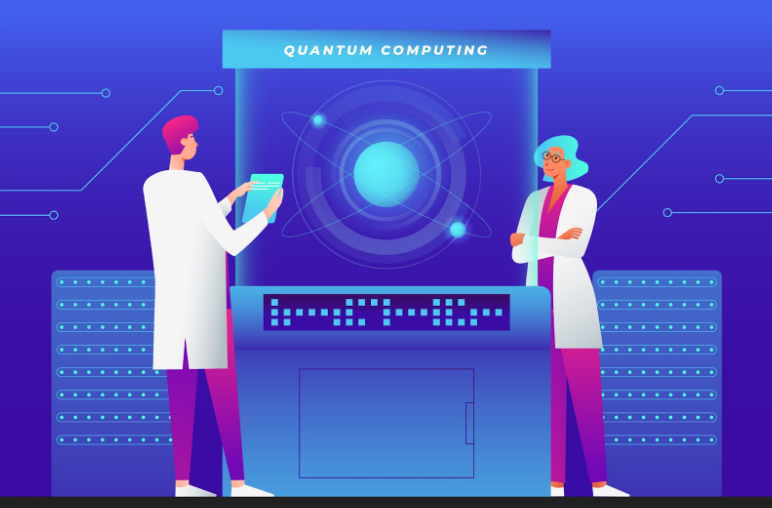
However, new risks are also emerging. The same advances fueling defense can empower adversaries to launch AI powered phishing attacks, which exploit human behavior at scale. This makes it crucial for organizations to combine quantum-era defenses with strong human risk management strategies. Advanced quantum AI dashboard displaying healthcare with real-time analytics and predictive modeling
What Challenges Must Quantum AI Overcome?
Quantum AI promises to offer great opportunities, but it has equally challenging technical and practical issues that scientists are striving to address.
-
Quantum Decoherence
Quantum states are highly delicate; a slight change in the environment is enough to ruin them. This is why a quantum computer today requires near-zero temperatures and must be free of all interference.
-
Error Rates
Quantum states are sensitive, and quantum operations may break down. The latest quantum computers from IBM offer gate fidelity at 99.9 percent. Nevertheless, it is hard to construct fault-tolerant quantum computing.
-
Scalability Issues
Building quantum computers with thousands of stable qubits remains technically challenging. Current systems have fewer than 1,000 qubits, while practical applications may require millions.
-
Practical Limitations
Quantum computing has a number of issues. The machines cost millions and require dedicated facilities to use, very high prices indeed. It also lacks professional people in the field which delays the achievement. And quantum systems require special cooling systems and cannot easily be linked to the existing standard computer systems.
The Future Landscape: What’s Next for Quantum Computing and AI?
The partnership of artificial intelligence and quantum computing is gaining momentum faster than ever before. Big tech companies are investing billions into research and development. Quantum computing resources are becoming more accessible to a broader audience through Amazon Braket, Google’s quantum AI department, and Microsoft Azure Quantum platform.
Emerging Trends
Hybrid Systems
In the future, we are likely to have hybrid machines, which combine traditional computers with quantum processors. Think of it as how we currently use ai to create digital content, with human supervision. But in this case, classical machines will perform routine duties, while quantum machines will focus on complex optimization and simulation.
Quantum Machine Learning
Quantum computers are beginning to appear with new algorithms that are structure-matched to them. Quantum Approximate Optimization Algorithms (QAOA) and Variational Quantum Eigensolvers (VQE) are promising to be applied in real life.
Cloud-Based Quantum AI
Quantum computers are made friendly with the cloud pbx platforms. Quantum systems allow scientists and startups to experiment without investing vast amounts in the laboratory.
Investment and Growth
Quantum technology investment in the first 5 months of 2025 has already reached nearly three-quarters of 2024’s total, indicating a powerful shift toward strategic funding rounds.
Major corporations are establishing quantum research divisions:
- IBM: Quantum Network includes over 200 academic institutions and companies
- Google: Achieved quantum supremacy and continues advancing quantum AI research
- Microsoft: Investing in topological qubits for more stable quantum systems
- Amazon: Braket service provides access to quantum computers from multiple vendors
Final Statement
The combination of quantum computing and artificial intelligence is the next crucial step for humanity in terms of technology development. Such a mighty duo can address the issues that a few years ago did not seem possible.
The quantum AI has arrived. AI development services provider aim to be forward-thinking are already adopting the use of these tools to derive the benefits and generate new ideas. The future possibilities are boundless as quantum machines will be more accessible and AI programs will become more intelligent.
Whether quantum AI will change our world is not a question. The whole point is whether you will be prepared to wield its power. The person who welcomes quantum mechanics and artificial intelligence in the present will shape the future.
FAQs
Quantum computing is about exponentially more powerful computing using quantum mechanics, whereas AI is about machine learning algorithms and AI pattern recognition.
Quantum AI will help scientists develop new medicines faster, improve weather prediction, prevent hacking and increase financial services efficiency in everyday life.
Use cases of quantum AI are already beginning to exist, and we are more likely to see them being common in certain sectors in the years 2025-2030.
Quantum AI enhances security through quantum encryption but also poses challenges to current security methods, driving new protection developments.
The careers in quantum AI include an acquaintance with quantum physics, computer science, mathematics, and machine learning algorithms, and programming expertise.


