Imagine an enterprise where decisions and solutions are made before issues arise, workflows are streamlined in real time, and employee productivity increases. This may seem futuristic, but with AI agents, numerous businesses are achieving these goals without spending significant amounts of money.
What Are AI Agents?
AI agents are autonomous or semi-autonomous software entities designed to achieve specific goals by interacting with their environment. Unlike a standard chatbot that simply generates text, an AI agent can use tools, access databases, and execute actions across different software platforms.
AI Agents vs. Automation: The Key Difference
Many leaders ask: Are AI agents just a new name for Robotic Process Automation (RPA)? Not exactly. While traditional automation follows rigid “if-this-then-that” rules, AI agents use reasoning to handle ambiguity.
| Feature | Traditional Automation (RPA) | AI Agents (Agentic AI) |
| Logic | Fixed, rule-based scripts | Probabilistic reasoning (LLMs) |
| Adaptability | Breaks if the UI or input changes | Adapts to context and re-learns |
| Learning | Static; requires manual updates | Refines performance via feedback loops |
How AI Agents Work: The Agentic Cycle
To understand how AI agents work, think of them as operating in a continuous loop known as Sense → Think → Act → Learn.
- Sense: The agent gathers data from your ecosystem, APIs, real-time customer logs, or internal databases.
- Think: Using reasoning engines and Large Language Models (LLMs), the agent breaks down a complex goal (e.g., “Onboard this new client”) into a series of logical steps.
- Act: The agent executes these steps, such as sending emails, updating a Customer Relationship Management (CRM), or generating a contract.
- Learn: In 2026, the most advanced agents use Reinforcement Learning from Human Feedback (RLHF) to improve their accuracy based on how successful their previous actions were.
Types of AI Agents
Understanding how AI agents function is only the first step; the real challenge lies in matching the right type of agent to your specific business needs.
Not all agents are created equal. For instance, your marketing team looking to scale content production needs a generative agent capable of publishing blogs at high speed. This is a cost-effective alternative to expanding the headcount. However, that same agent would be entirely ineffective if repurposed for the customer service department, where a goal-based agent is required to navigate complex technical troubleshooting or route calls to human representatives.
To maximize your ROI, you must align the agent’s specialized architecture with your operational goals. Below, we break down the primary categories of AI agents and where they provide the most value.
- Simple Reflex Agents: Operate on predefined rules (e.g., spam filters, auto-responses). Fast but limited in adaptability.
- Model-Based Agents: Maintain an internal state or memory to make context-aware decisions. Useful in dynamic workflows in industries like logistics or banking.
- Goal-Based Agents: Plan actions to achieve defined objectives, such as recommendation engines in e-commerce.
- Utility-Based Agents: Evaluate outcomes to maximize expected business value, which is common when you are looking to optimize your supply chains.
- Learning Agents: Continuously improve performance through feedback and data, enhancing dynamic processes like fraud detection or customer service.
- Autonomous Multi-Agent Systems (MAS): These are groups of specialized agents that collaborate; one handles research, another handles drafting, and a third handles compliance.
Each type offers distinct advantages, allowing you to choose the right agent for your specific business use cases.
Strategic Ways You Can Leverage AI Agents in Business
It is known that using AI in business has helped leaders achieve many benefits, including strong ROI. With AI agents, leaders can take this one step further.
AI agents deliver significant value across industries, making them indispensable to every enterprise. Leverage AI agents to:
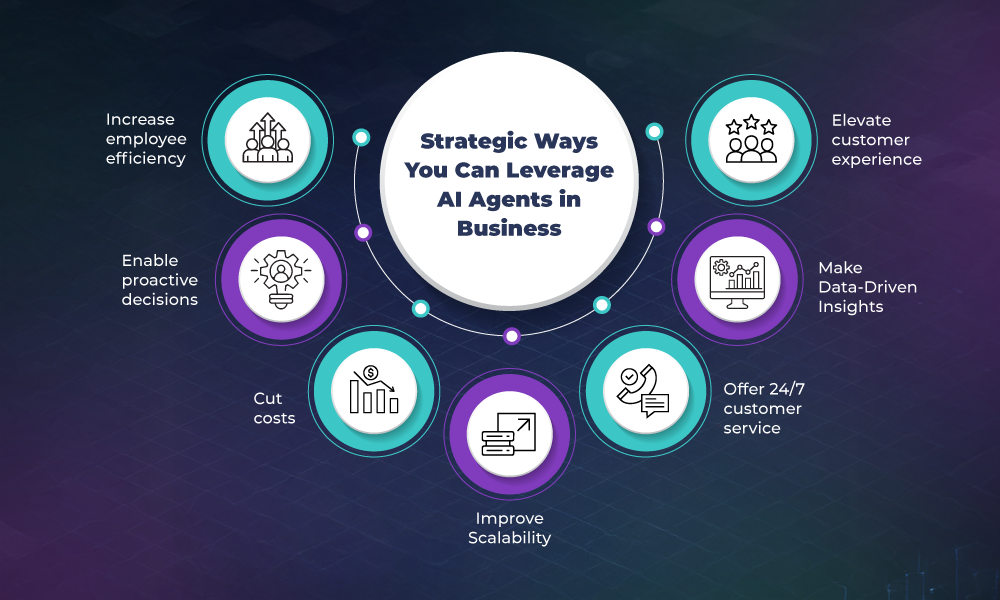
- Increase employee efficiency: Automate repetitive, high-volume tasks more quickly and accurately, empowering your employees to focus on more strategic work.
- Enable proactive decisions: Predict issues and act before they arise.
- Cut costs: Minimize manual errors and optimize resource allocation.
- Improve Scalability: Support business operations as user traffic increases without overloading current employees.
- Offer 24/7 customer service: Deliver consistent, high-quality support anywhere, anytime.
- Make Data-Driven Insights: Leverage real-time analytics from operations and customer interactions to make informed decisions instead of relying on hunches.
- Elevate customer experience: Personalize and scale customer service regardless of their geographical location or demographics.
What are the Governance Guardrails Business Leaders Need to Know Before Integrating AI Agents in Business
Even though there are many benefits of using AI agents, their autonomous capabilities create new organizational risks. Enterprise leaders should prioritize data transparency, ensure AI agents align with regulatory and compliance standards, and implement rigorous vendor oversight when outsourcing AI development services.
Effective governance ensures that every stakeholder, from partners to end-customers, understands how their data is being processed and by whom. Leaders should focus on three core pillars:
- Transparency & Traceability: The AI agents should be able to provide reasoning trails that enable human workers to verify the reasoning used to make a particular decision. This is important for building trust and ensuring that AI agents comply with current laws, such as the EU AI Act.
- Data Sovereignty: Enterprise leaders should ensure that the AI agents are able to access data in a manner that is strictly controlled by permissions that are guided by “Privacy by Design” to ensure that there is no unauthorized access to data by individuals or entities.
- Accountability in Outsourcing: Even if the enterprise leaders choose to outsource the development of AI agents, the enterprise leaders will still be held accountable. Service providers should be able to demonstrate compliance with global data protection laws (such as GDPR, HIPAA, or the Digital Personal Data Protection Act) through third-party audits.
The Future of AI Agents
As AI agents are now built leveraging Large language models (LLMs), machine learning (ML), and natural language processing (NLP), AI agents are headed towards:
- Multi-agent ecosystems: Smooth interaction between various AI agents for automating complex tasks.
- Continuous learning and adaptation: AI Agents improve their performance through feedback mechanisms.
- Increased industry adoption: Business leaders can utilize AI agents in finance, healthcare, manufacturing, marketing, and trade.
- Increased autonomy and intelligence: Minimizing human intervention and maximizing decision-making speed and accuracy.
Wrapping Up
AI agents are more than technology trends; they are strategic assets that maximize operational efficiency. By automating repetitive tasks and delivering actionable insights, these agents enable teams to focus on developing strategies that create greater business value. This means faster decision-making, greater customer satisfaction, and more efficient resource utilization. With effective governance and oversight, AI agents become valuable partners in pursuing efficiency and business growth, making your organization a leader in innovation for 2026 and beyond.